Nara day trip: deer, Todai-ji and Kasuga Taisha in one day
Updated
A Nara day trip is the shortest step back in time from Osaka or Kyoto: the Kintetsu Rapid Express from Osaka-Namba reaches Kintetsu-Nara in 37 minutes for 680 yen, and a direct Express from Kyoto takes about 48 minutes. From the station, the old temples, the deer and the shrine forest all lie within one walkable park.
The day here runs east from the station, from Kofuku-ji through the deer park to the Great Buddha at Todai-ji, then south through the lantern paths of Kasuga Taisha and back through the lanes of Naramachi. It needs no booking and suits a slow pace.
Nara day trip at a glance
- From Osaka: Osaka-Namba to Kintetsu-Nara, 37 minutes on the Kintetsu Rapid Express, 680 yen, no seat ticket.
- From Kyoto: Kyoto to Kintetsu-Nara, about 48 minutes on a direct Kintetsu Express for 760 yen, or 34 minutes on the Limited Express for 1,280 yen including the seat fee. The JR Miyakoji Rapid to JR Nara takes about 45 minutes, approximate, but JR Nara Station is further from the park.
- The walk: Kintetsu-Nara to Todai-ji is about 20 minutes on foot, and Kasuga Taisha is about 25 minutes from the station.
- Entry fees: the Great Buddha Hall at Todai-ji is 800 yen for adults. Kasuga Taisha's grounds are free, and the inner sanctuary is 700 yen.
- Bookings: none needed.
Is a Nara day trip worth it?
For a first visit to Kyoto or Osaka, yes. Nara was Japan's capital in the 8th century, and its great temples were founded before Kyoto became the capital. The Great Buddha Hall alone is worth the trip, and the deer that wander between the temples make the day feel unlike any other in Japan.
It also asks little of you. The train ride is under an hour, there is nothing to book, and the main sights are close together, so you can turn back early without losing much. If time is short, Todai-ji and the deer fill a calm half day.
Getting there from Osaka or Kyoto
From Osaka, start at Osaka-Namba. The Kintetsu Rapid Express to Kintetsu-Nara takes 37 minutes for 680 yen, with no surcharge and no seat to reserve, so you can simply tap in with an IC card or buy a ticket at the machine.
From Kyoto, Kintetsu trains leave from their own platforms at Kyoto Station. A direct Express via Yamato-Saidaiji takes about 48 minutes for 760 yen. The Limited Express takes 34 minutes for 760 yen plus a 520 yen limited express fee, 1,280 yen in all, and seats can be searched from 10:30 a month before. JR's Miyakoji Rapid to JR Nara takes about 45 minutes, approximate, and stops at Inari for Fushimi Inari on the way, but the walk to the park is longer from JR Nara than from Kintetsu-Nara.
Kintetsu-Nara is the station to aim for. Kofuku-ji is a few minutes' walk away, and Todai-ji is about 20 minutes east along Noborioji Street.
A day plan for Nara
- 9:00: arrive at Kintetsu-Nara and walk up to Kofuku-ji.
- 9:30 to 10:30: cross Nara Park towards Todai-ji, with time for the deer on the way.
- 10:30 to 12:00: the Great Buddha Hall at Todai-ji, then the walk up the slope to the Hokke-do and the Nigatsu-do for the view over the city.
- 12:00 to 13:00: lunch near the park or on the way down.
- 13:00 to 14:30: walk south to Kasuga Taisha along the lantern-lined approach.
- 14:30 to 16:00: back through Naramachi and past Sarusawa Pond to the station.
All times are a guide. In winter the Great Buddha Hall closes at 17:00, so keep it for the morning, when the crowds are also lighter.
Kofuku-ji
Kofuku-ji is the first temple you meet, a few minutes up the hill from Kintetsu-Nara. Its five-storey pagoda was first raised in 730, and the present one dates from 1426. At 50.1 metres it is the second-tallest wooden pagoda in Japan.
For now, the pagoda stands inside a temporary protective building about 60 metres tall, put up for its first major repair in about 120 years. The work is scheduled to finish in March 2034. The temple grounds stay open to walk through, and they are a gentle start before the park opens out.
Nara Park and the deer
Beyond Kofuku-ji the trees thin into Nara Park, where sika deer roam freely. They are wild animals, protected as a National Natural Monument and long regarded as sacred to Kasuga Taisha, so treat them as you would any wild animal, even when they come close.
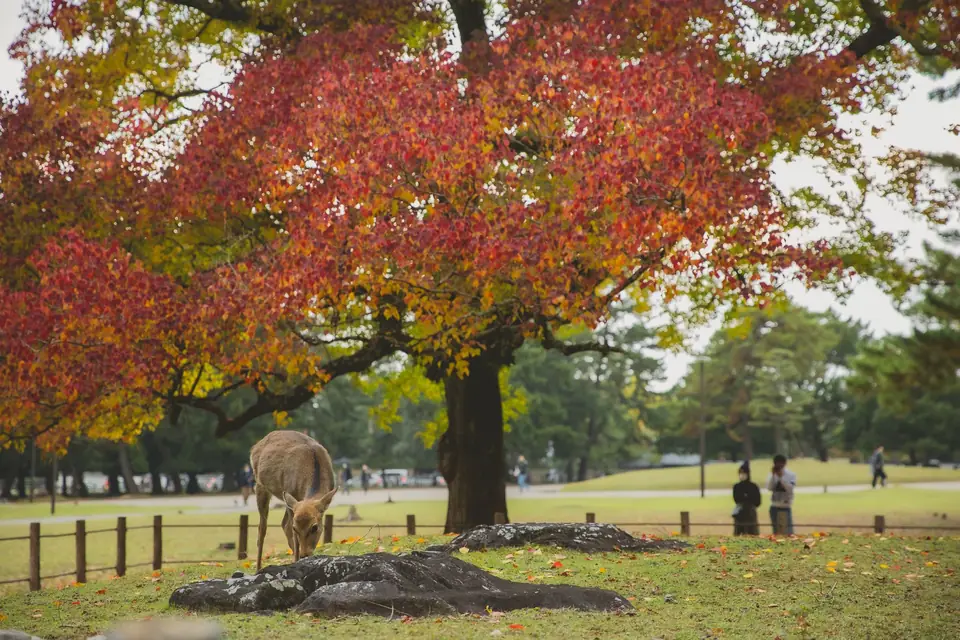
Deer crackers, called shika senbei, are sold at stalls around the park for about 200 yen for a pack of 10. They are made for the deer and are the only food the deer should ever be given. Hand them over one at a time and without teasing, and when the pack is empty, show your open, empty hands so the deer know feeding is over.
A little care keeps it pleasant. Hold your bag, map and tickets close, since the deer will try to eat paper. Keep small children with an adult while they feed the deer. Give the does space in spring, when they are protecting fawns, and the stags space in autumn, the mating season, when they can be aggressive. Take your rubbish with you, because plastic left in the park can kill a deer.
Todai-ji and the Great Buddha
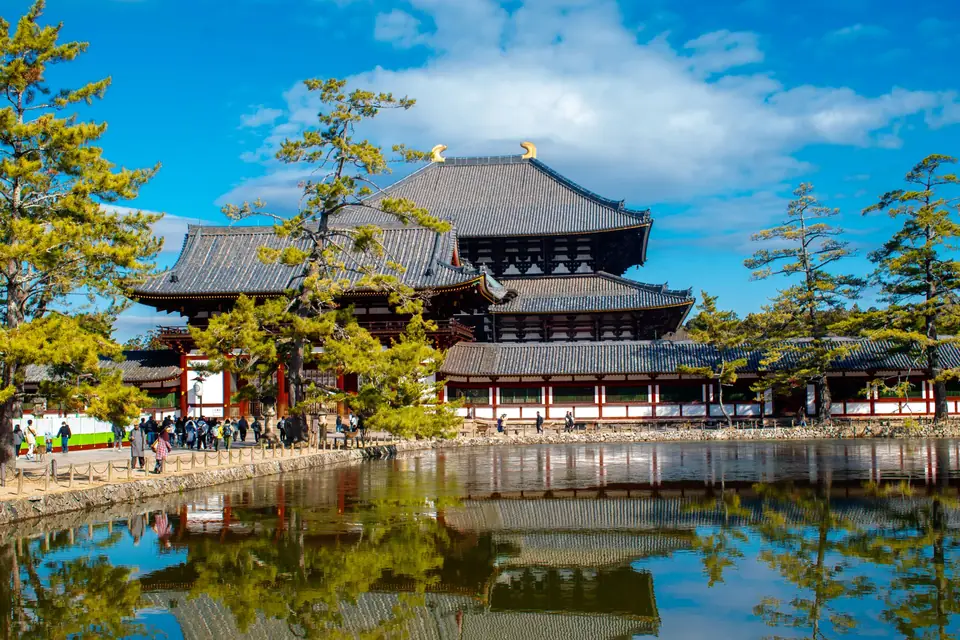
Todai-ji's Great Buddha Hall, the Daibutsu-den, holds the Great Buddha, a seated figure that fills the space above you as you step inside. The walk from the main gate to the hall is a slow build, and it is worth reaching early, before the tour groups.
The hall opens from 7:30 to 17:30 from April to October and from 8:00 to 17:00 from November to March. Entry is 800 yen for adults and 400 yen for ages 6 to 12, or 1,200 yen and 600 yen with the Todai-ji Museum, which opens from 9:30. An audio guide can be rented for 500 yen just past the gate.
From the hall, the path climbs east to the Hokke-do, open from 8:30 to 16:00, and on to the Nigatsu-do, whose wooden veranda looks out over the roofs of Nara. It is one of the quieter corners of the day.
Kasuga Taisha and the lantern paths
Kasuga Taisha was founded in 768, and about 3,000 lanterns, all donated, line its approaches and hang in its corridors. The walk in from the park, through tall cedars and rows of moss-covered stone lanterns, is as much the point as the shrine itself. It is about 25 minutes on foot from Kintetsu-Nara, or a little less from the park.
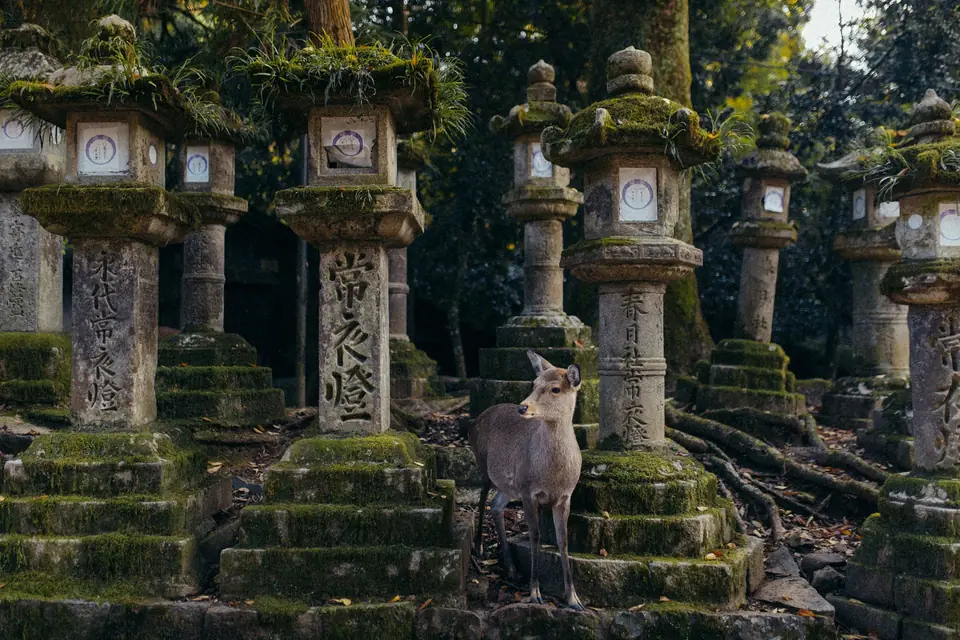
The grounds open from 6:30 to 17:30 from March to October and from 7:00 to 17:00 from November to February, and walking them is free. The Special Worship of the main sanctuary, from 9:00 to 16:00, is 700 yen. It closes from 8 to 13 March and from 20 December to 7 January, and in the mornings on the 1st, 11th and 21st of each month and on festival days. The shrine museum and the Man'yo Botanical Garden are 700 yen each if you have more time.
Naramachi and the walk back
South of Sarusawa Pond, Naramachi is the old merchant quarter, a few streets of low wooden townhouses, small cafes and craft shops. It is free to wander and makes an easy end to the day on the way back to Kintetsu-Nara. Sarusawa Pond itself, just below Kofuku-ji, gives a last view of the temple roofs over the water.
If the day runs short
Keep Todai-ji and the deer, and drop the rest. The Great Buddha Hall and the walk through the park take about two hours together and are the heart of the day. Kasuga Taisha is the next to add if you have the energy, and Naramachi can be skipped without regret.
What to book early
- Nothing in Nara itself: Todai-ji, Kasuga Taisha and the park need no booking. Buy temple tickets at the gate.
- The Kintetsu Limited Express from Kyoto: if you want the 34 minute train, seats can be searched from 10:30 a month before. The Express and, from Osaka, the Rapid Express need no seat ticket.
- Your Kyoto or Osaka hotel: book a few months ahead for cherry blossom season in late March and early April and for the autumn leaves in November, when Nara is also at its busiest.
- Tickets that sell out: the Japan booking guide has the dates for the tickets elsewhere in Japan that sell out.
From Singapore
Japan (JST, UTC+9) is 1 hour ahead of Singapore (UTC+8) all year, and neither uses daylight saving. Singapore to Osaka Kansai is about 6 hours non-stop, approximate, and Kansai International Airport serves both Osaka and Kyoto, so Nara fits naturally into a Kansai trip.
A Singapore passport does not need a visa for a short-term stay of up to 90 days, for sightseeing, visiting friends or business meetings, and not for paid work. Japan enacted a law on 29 May 2026 (promulgated 5 June 2026, Act No. 32 of 2026) creating JESTA, an online travel authorisation for visa-exempt visitors. It starts on a date set by Cabinet Order, no later than 31 March 2029. Nothing new is needed yet.
For a Singapore long weekend, see the Singapore public holidays 2027 page. Nara works best as one day inside a longer stay in Osaka or Kyoto.
Planning this trip as a group
- Pick the station together. If part of the group stays in Osaka and part in Kyoto, meet at Kintetsu-Nara rather than travelling together.
- Buy deer crackers one pack at a time. A group holding several packs draws a crowd of deer, so take turns rather than opening them all at once.
- Let the pace split. Some may want the climb to the Nigatsu-do while others rest by the pond. Agree a meeting point, such as the Todai-ji main gate, and a time.
- Keep the plan in one place. With Tripmo's group trip planner, each person's ChatGPT, Claude or Grok adds to one shared plan on a map, so train times and meeting points don't get lost in the group chat.
More Japan itineraries
- Kyoto vs Osaka: where to stay, and where Nara fits
- 3 days in Kyoto: temples, gardens and Fushimi Inari, with a Nara option
- 3 days in Osaka: Osaka Castle, Dotonbori and a day trip to Nara
- 7 days in Japan: Tokyo, Kyoto and Osaka in one week
- All Japan itineraries
Sources
- Kintetsu Railway, route search: Osaka-Namba to Kintetsu-Nara in 37 minutes on the Rapid Express for 680 yen with no surcharge; Kyoto to Kintetsu-Nara on a direct Express via Yamato-Saidaiji in about 48 minutes for 760 yen, or 34 minutes on the Limited Express for 760 yen plus a 520 yen fee; limited express seats from 10:30 a month before. Updated 4 November 2026.
- Todai-ji, visiting information: Great Buddha Hall hours of 7:30 to 17:30 from April to October and 8:00 to 17:00 from November to March, 800 yen for adults and 400 yen for ages 6 to 12, the joint ticket with the museum at 1,200 yen and 600 yen, museum hours from 9:30, Hokke-do 8:30 to 16:00, and the 500 yen audio guide. Updated 4 November 2026.
- Todai-ji, access: about 20 minutes on foot from Kintetsu-Nara along Noborioji. Updated 4 November 2026.
- Kasuga Taisha, basic information: founded in 768, about 3,000 lanterns, grounds hours by season, Special Worship from 9:00 to 16:00 at 700 yen and its closures, the museum and the Man'yo Botanical Garden at 700 yen, about 25 minutes on foot from Kintetsu-Nara. Updated 4 November 2026.
- Kohfukuji, Five-storied Pagoda: first raised in 730, rebuilt in 1426, 50.1 metres, the second-tallest wooden pagoda in Japan.
- Kohfukuji five-storied pagoda conservation project: the temporary covering of about 60 metres completed in March 2025, the first major repair in about 120 years, and completion scheduled for March 2034, and the move of the capital to Heijo-kyo, today's Nara, in 710. Updated 4 November 2026.
- Nara City Tourism Association, the deer of Nara Park: deer crackers at 200 yen for a pack of 10 (2024 price, so approximate), feeding one at a time, and showing empty hands when finished.
- Nara Prefecture, protecting the Nara deer (PDF): the deer are wild, protected as National Natural Monuments and sacred to Kasuga Taisha; feed them only deer crackers; keep children with an adult; avoid does in the birthing season and stags in the mating season; take rubbish home.
- Ministry of Foreign Affairs of Japan, Exemption of Visa (Short-Term Stay): Singapore is listed, for 90 days.
- Immigration Services Agency of Japan: the law enacted on 29 May 2026 creating JESTA, starting no later than 31 March 2029.
- JR Kyoto to Nara times, walking times within the park and flight times: published timetables and maps, approximate and subject to change.
Questions
Is a day trip to Nara worth it?
Yes, for most first visits to Kyoto or Osaka. The train ride is under an hour, and the main sights, Kofuku-ji, the deer park, Todai-ji and Kasuga Taisha, sit close together in one park, so the day is mostly an easy walk.
How long do you need in Nara?
A full day covers Todai-ji, the deer and Kasuga Taisha at a calm pace, with time for Naramachi. Half a day is enough for Todai-ji and the deer if you are short of time.
Is it better to visit Nara from Osaka or Kyoto?
Both work. The Kintetsu Rapid Express from Osaka-Namba takes 37 minutes for 680 yen. From Kyoto, a direct Kintetsu Express takes about 48 minutes for 760 yen, or 34 minutes on a Limited Express for 1,280 yen with the seat fee.
How much are deer crackers in Nara?
About 200 yen for a pack of 10, sold at stalls around Nara Park. The deer must not be fed anything else.
Do you need to book anything for a Nara day trip?
No. Todai-ji, Kasuga Taisha and the park need no booking, and the Rapid Express from Osaka-Namba needs no seat ticket. Only the Kintetsu Limited Express from Kyoto takes a reserved seat.
Is the Kofuku-ji pagoda covered?
Yes. The five-storey pagoda is inside a temporary protective building for its first major repair in about 120 years, with completion scheduled for March 2034.
Plan this trip together.
Start a trip in Tripmo, send your friends its link, and everyone adds to the plan with their own AI.
Start planning