Mt Fuji day trip from Tokyo: Kawaguchiko, trains and timings
Updated
A Mt Fuji day trip from Tokyo usually means Kawaguchiko, the lakeside town at the foot of the mountain, about 2 hours from Shinjuku by train or bus. The Fuji Excursion train is 4,200 yen one way and the highway bus is 2,000 yen online, and a day there fits the Chureito Pagoda, a ropeway ride and the north shore of Lake Kawaguchi.
This guide sets out the two ways to get there, a day plan that starts with the best view, how the local buses work, and how to give yourself the best chance of a clear mountain.
The day at a glance
All times are approximate and follow the morning train:
- 7:30: the Fuji Excursion leaves Shinjuku.
- About 9:10: off at Shimoyoshida for the Chureito Pagoda, about 25 minutes on foot and 398 steps up.
- About 10:45: a short local train on to Kawaguchiko.
- 11:15 to 12:30: the Mt. Fuji Panorama Ropeway above Lake Kawaguchi.
- 12:30 to 14:00: lunch near Kawaguchiko Station.
- 14:00 to 16:15: the Red Line bus around the north shore to Oishi Park, and back.
- 16:48: the Fuji Excursion back to Shinjuku, arriving in the early evening. The highway bus is the cheaper way home.
Getting there: train or bus
The Fuji Excursion train runs from Shinjuku to Kawaguchiko, joined to a JR limited express as far as Otsuki and then running on the Fujikyu line to the lakes. The fastest trip is 1 hour 53 minutes. The adult fare to Kawaguchiko is 4,200 yen one way, which is the basic fare of 2,580 yen plus a limited express charge of 1,620 yen, and Shimoyoshida, the stop for the pagoda, is 4,010 yen.
There are four round trips a day, plus one more in busy seasons. On the timetable from 14 March 2026, trains leave Shinjuku at 7:30, 8:30, 9:30 and 10:30, and leave Kawaguchiko for Shinjuku at 14:08, 14:58, 16:48 and 17:41. There are no unreserved cars: you either reserve a seat or buy a date-only ticket that lets you sit in any seat left empty. Seats go on sale at 10:00 one month before.
The highway bus leaves from Busta Shinjuku, on the fourth floor, about 2 minutes from the JR Shinjuku New South Gate. It takes about 1 hour 45 minutes to Kawaguchiko Station, with more than 65 departures a day from 6:45. The adult fare is 2,000 yen online or 2,200 yen at the counter, and 1,000 yen or 1,100 yen for a child. No tickets are sold on board, a screenshot of the ticket is not accepted, and each person can bring one large bag.
The bus is the better value and far more flexible. The train is the calmer ride on a busy weekend, when traffic on the expressway can stretch the bus trip, and it stops at Shimoyoshida, the station for the pagoda.
The Chureito Pagoda
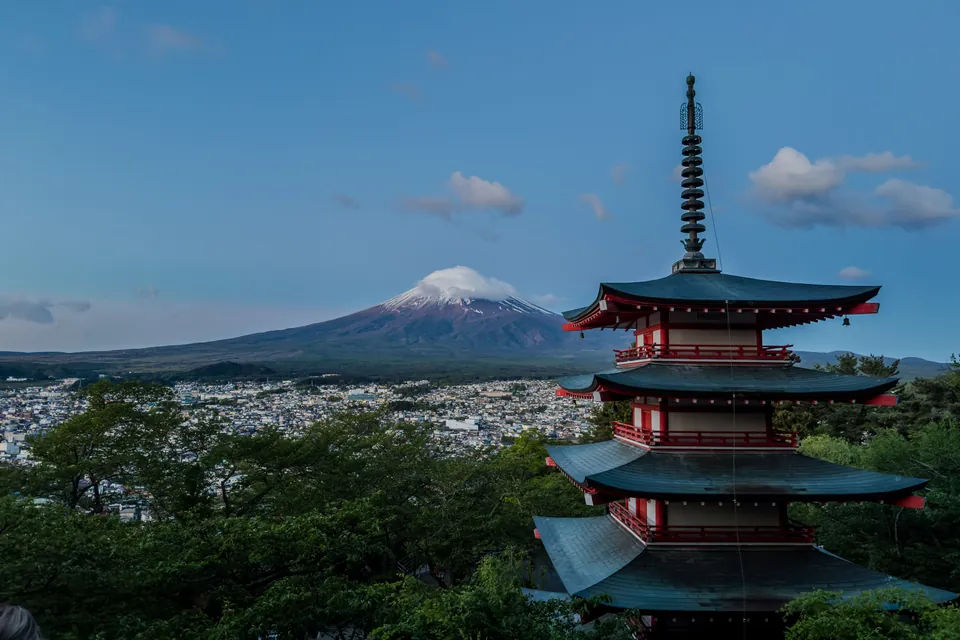
The red five-storey pagoda stands in Arakurayama Sengen Park, above the town of Fujiyoshida, and from the deck behind it Mount Fuji rises over the rooftops. It was built in 1958 as a memorial to the people of Fujiyoshida who died in the wars after 1868, so it is a place of remembrance as well as a view.
From Shimoyoshida Station it is about 25 minutes on foot, ending with 398 steps to the observation deck. The park is open at all hours. It is busy, especially at weekends, in cherry blossom season in April and in autumn, and the city asks visitors not to drive, since the lanes are narrow and parking is limited. An early arrival is quieter and usually clearer.
From Shimoyoshida, the Fujikyu local train runs on to Kawaguchiko in about 15 minutes, approximate.
Lake Kawaguchi and the ropeway
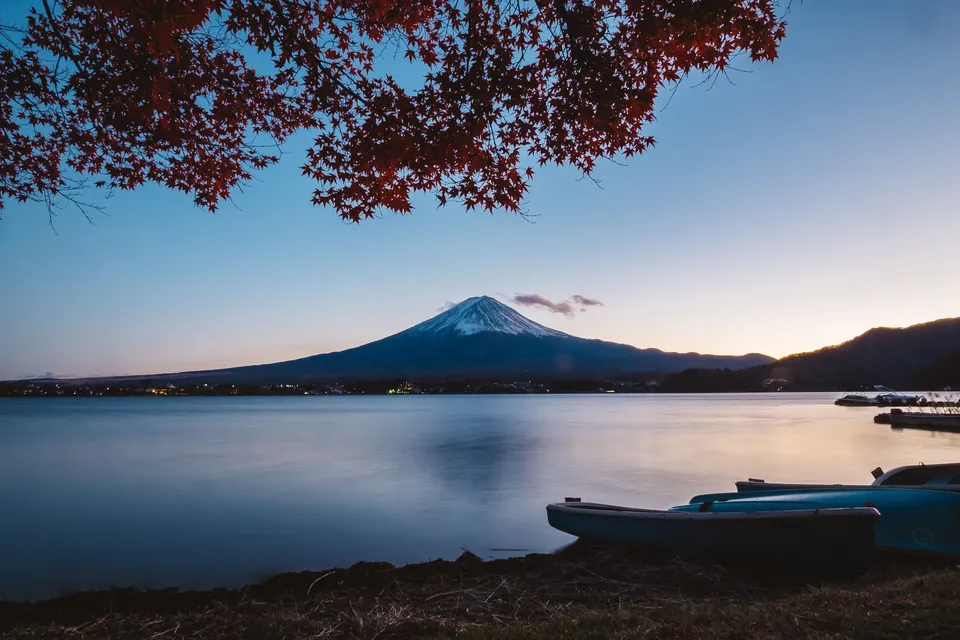
Kawaguchiko is the base for the north side of the lakes. The Mt. Fuji Panorama Ropeway climbs in about 3 minutes from the lakeside to a deck at 1,075 metres, with Mount Fuji on one side and the lake below. From 1 November 2026 the round trip is 1,200 yen for adults and 600 yen for children, and a one way ticket is 800 yen and 400 yen. The ropeway normally runs from 8:30 to 17:00, with seasonal changes, and it closes for a few days of inspection each winter, so check its page before you go.
Lunch fits near the station afterwards. Hoto, the thick noodle stew of Yamanashi, is the local dish, and it is especially welcome on a cold day.
Getting around the lakes
The Fujikyu sightseeing buses do the work of a car. The Red Line circles the north shore of Lake Kawaguchi, past the ropeway and on to Oishi Park, where the lakeside view of Mount Fuji is one of the best known. The Green Line goes west to Lake Saiko, the Aokigahara forest and the Narusawa Ice Cave, and the Blue Line runs on to Lakes Shoji and Motosu.
No reservation is needed. A single ride starts at 180 yen, and a 1 day pass is 1,500 yen for adults and 750 yen for children, or 2,000 yen and 1,000 yen for 2 days. The pass is simplest if you plan to hop on and off along the shore.
When Mount Fuji is most likely to be clear
The mountain makes its own weather, and many visitors arrive to find it hidden. The bus operator for the Shinjuku route recommends the morning, from about 6:00 to 9:00, as the best time to see it, says it is easier to see in winter, and notes that clouds tend to build in the afternoon in summer. A day trip from autumn to early spring, started early, gives the best odds.
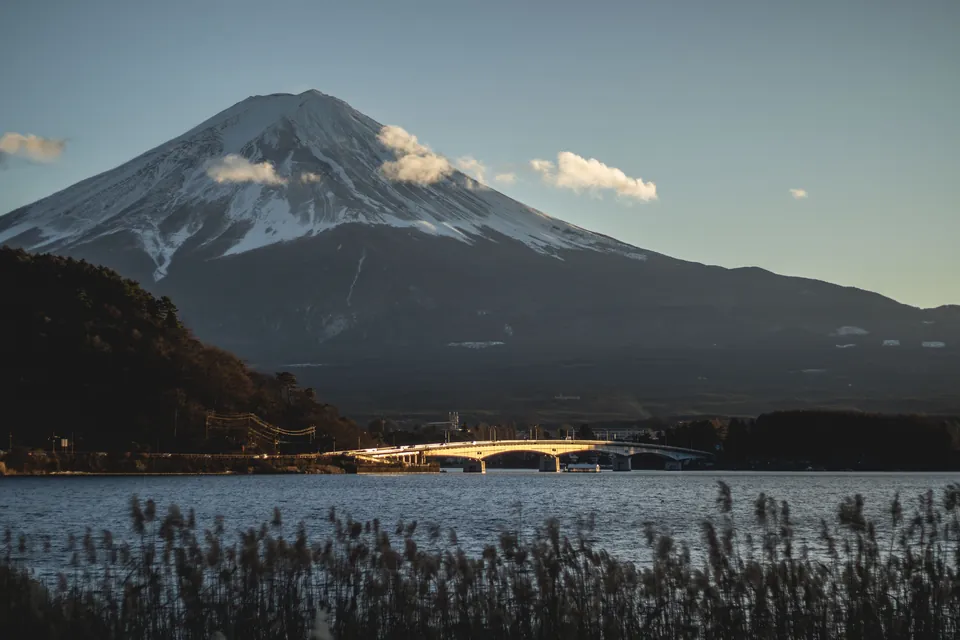
Check the live camera at Oishi Park and the visibility forecast on the morning you go. If the forecast is poor and your dates allow it, swap the Fuji day with a Tokyo day.
If the day runs short
Keep the pagoda and one lake. The simplest cut is to drop the ropeway and ride the Red Line straight to Oishi Park, or to stay on the train to Kawaguchiko and skip the pagoda if the mountain is already behind cloud. If you would rather spend a night, a lakeside stay lets you catch the clear early morning without the 7:30 train.
What to book early
- Fuji Excursion seats: they go on sale at 10:00 one month before, and the train has no unreserved cars, so book the morning train as soon as your date is fixed.
- Highway bus tickets: buy online ahead for the time you want. Tickets are not sold on board, and weekend mornings are the busiest.
- A lakeside hotel: if you want to stay the night, book weeks ahead for autumn leaves, cherry blossom season and weekends.
- Other trips from Tokyo: the 5 days in Tokyo plan and the 7 days in Japan route show where a Fuji day fits. The Japan booking guide has the dates for the tickets that sell out.
From Singapore
Japan (JST, UTC+9) is 1 hour ahead of Singapore (UTC+8) all year, and neither uses daylight saving. Non-stop flights from Singapore to Tokyo Haneda and Narita take about 7 hours, approximate, and Shinjuku, where both the train and the bus to Kawaguchiko start, is easy to reach from both.
A Singapore passport does not need a visa for a short-term stay of up to 90 days, for sightseeing, visiting friends or business meetings, and not for paid work. Japan enacted a law on 29 May 2026 (promulgated 5 June 2026, Act No. 32 of 2026) creating JESTA, an online travel authorisation for visa-exempt visitors. It starts on a date set by Cabinet Order, no later than 31 March 2029. Nothing new is needed yet.
For a Singapore long weekend, see the Singapore public holidays 2027 page. Kawaguchiko is easiest as a single day inside a longer Tokyo stay, rather than a trip of its own.
Planning this trip as a group
- Book the seats together. One person buying all the train seats or bus tickets in one order keeps the group in the same car or coach.
- Agree on a weather plan. Decide the night before whether the forecast is good enough, and which Tokyo day you would swap if it is not.
- Set a meeting point. If some of the group skip the 398 steps, agree a time to meet at Shimoyoshida Station or at the ropeway.
- Keep the plan in one place. With Tripmo's group trip planner, each person's ChatGPT, Claude or Grok adds to one shared plan on a map, so tickets and timings don't get lost in the group chat.
More Japan itineraries
- Hakone day trip from Tokyo: the loop by train, ropeway and boat, with Fuji views on a clear day
- 5 days in Tokyo: neighbourhood days, with a day trip option
- 7 days in Japan: Tokyo, Kyoto and Osaka in one week
- All Japan itineraries
Sources
- Fujikyu Railway, Fuji Excursion: Shinjuku to Kawaguchiko at 4,200 yen (basic fare 2,580 yen and limited express 1,620 yen), Shimoyoshida at 4,010 yen, the fastest time of 1 hour 53 minutes, four round trips a day plus a seasonal one, the timetable from 14 March 2026, no unreserved cars, and seats on sale at 10:00 one month before. Updated 5 November 2026.
- Fujikyu Bus, Shinjuku to Kawaguchiko highway bus: Busta Shinjuku 4F, about 1 hour 45 minutes, more than 65 departures a day from 6:45, 2,000 yen online and 2,200 yen at the counter, child 1,000 yen and 1,100 yen, no tickets on board, no screenshots, one large bag per person.
- Fujiyoshida City Tourism, Arakurayama Sengen Park: the Chureito Pagoda, 398 steps to the observation deck, open at all hours, about 25 minutes on foot from Shimoyoshida Station.
- Fujiyoshida City, Chureito Pagoda: built in 1958 as a memorial, and the congestion and limited parking at weekends and in cherry blossom and autumn seasons.
- Mt. Fuji Panorama Ropeway, fares and hours: about 3 minutes to the 1,075 metre deck, fares from 1 November 2026 of 1,200 yen round trip and 800 yen one way for adults, 600 yen and 400 yen for children, and normal hours of 8:30 to 17:00. Updated 5 November 2026.
- Fujikyu Bus, Kawaguchiko sightseeing buses: the Red, Green and Blue Lines, single rides from 180 yen, and the 1 day pass at 1,500 yen and 750 yen and 2 day pass at 2,000 yen and 1,000 yen, with no reservation needed.
- Chuo Highway Bus, Mt. Fuji conditions: the visibility forecast, the live camera at Oishi Park, and the advice that 6:00 to 9:00 and winter are the best times to see the mountain.
- Ministry of Foreign Affairs of Japan, Exemption of Visa (Short-Term Stay): Singapore is listed, for 90 days.
- Immigration Services Agency of Japan: the law enacted on 29 May 2026 creating JESTA, starting no later than 31 March 2029.
- Flights, the local train from Shimoyoshida and walking times: published schedules, approximate and subject to change. No fares.
Questions
How long does it take to get from Tokyo to Mt Fuji?
About 2 hours each way to Kawaguchiko, the main town of the Fuji Five Lakes. The Fuji Excursion train from Shinjuku takes from 1 hour 53 minutes, and the highway bus from Busta Shinjuku about 1 hour 45 minutes, longer in heavy traffic.
Is the train or the bus better for a Mt Fuji day trip?
The bus is cheaper, at 2,000 yen online, and runs far more often. The Fuji Excursion train costs 4,200 yen one way but avoids road traffic and stops at Shimoyoshida for the Chureito Pagoda.
Do I need to book the Fuji Excursion or the bus in advance?
It helps. Fuji Excursion seats go on sale at 10:00 one month before, and the train has no unreserved cars. Bus tickets are not sold on board, so buy them online or at the Busta Shinjuku counter before you travel.
When is Mount Fuji most visible?
In the morning and in winter. The bus operator recommends 6:00 to 9:00 as the best time to see it, and says clouds tend to build on summer afternoons. Check the live camera before you leave Tokyo.
Is a Mt Fuji day trip worth it if the mountain is hidden?
It is still a pleasant day of lakes and a ropeway, but the view is the reason most people go. If the forecast is cloudy, move the trip to a clearer day if you can.
Plan this trip together.
Start a trip in Tripmo, send your friends its link, and everyone adds to the plan with their own AI.
Start planning