Korean convenience store: what to buy in Seoul
Updated
A Korean convenience store in Seoul is the meal between stops. Triangle kimbap starts at about 1,200 won, a 240 ml bottle of banana milk is 1,800 won, and the ramyeon station has hot water, or a cooker where the shop has one.
GS25, CU, 7-Eleven and emart24 are the four you will keep seeing. The shelves overlap. The stickers and the cooker do not, so read the tag in the shop you are standing in.
What to buy
Triangle kimbap is the one to start with. Tuna mayo, and beef with gochujang, are about 1,200 won. Chicken mayo is about 1,400 won. A bigger triangle is about 1,700 to 1,800 won, and a double filling is about 2,200 to 2,300 won. Most packs have numbered pull tabs. Pull the top one first, then the sides, or the seaweed tears.
A full gimbap roll, spam and kimchi or bulgogi, is about 3,200 to 3,400 won. Same idea as the triangle, long enough to split.
A dosirak is lunch in a box: rice, a main and a few side dishes. A pork box is 5,500 won, and a nine-side box is 5,900 won. Most lunch boxes sit at about 5,200 to 5,900 won. A cheese pork cutlet box is 7,900 won. Ask at the counter if you want the box hot.
Banana milk is the 240 ml bottle in the fridge door, at 1,800 won. The strawberry and melon bottles sit beside it. A GS25 with a coffee machine is pay first, cup under the spout, then the button.
Fish cake and sausages sit in a warmer by the counter. Check the tag. The snack wall moves faster than the kimbap, so the sticker is the price that matters.
The ramyeon station
Two ways to cook. A shop may have one, or both.
Hot water is the one you can count on. Buy a cup, peel the lid halfway, and fill to the line. Close the lid and wait. The cup prints the minutes. Then the cup, the lid and the packet go in the bin.
A cooker is for a bag, not a cup. Not every branch has one. About a thousand CU shops do. Pay for the bag first. If the machine reads a barcode, scan the pack and it sets the water. If it has noodle buttons, empty the noodles and the soup into a bowl, set the bowl on the plate, press the button for that noodle, then start. Buldak is a stir-fried noodle, so it takes the stir-fried button, and that page has the buttons and the timer. Stir while it cooks, or the noodles stick. On a button machine it is about 4 to 5 minutes. Cheese or an egg takes the heat down. The bowl, the packet and the chopsticks go in the bin when you finish.
If the shop has a counter, eat there and clear it when you stand up. A small branch may only have standing room.
What it costs
Prices checked October 2026.
- A triangle kimbap is about 1,200 to 1,800 won, and a double is about 2,200 to 2,300 won
- A gimbap roll is about 3,200 to 3,400 won
- A lunch box is about 5,200 to 5,900 won, and a cheese pork cutlet box is 7,900 won
- Banana milk, 240 ml, is 1,800 won
A bag of ramyeon is the cheap end of the shelf. Check the tag, then cook it. Flavours and the machine are on the Buldak page.
Check the tag in front of you. It moves.
How to pay
Cards and cash both work at the counter. T-money pays at GS25, CU, 7-Eleven and emart24 when the logo is there. The card is about 3,000 to 5,000 won, and you load it with cash at the same counter. At emart24 a phone wallet works too, including Apple Pay and Samsung Pay. If a tap fails, use the chip or cash.
1+1 and 2+1
The shelf tag is the discount. A 1+1 sticker means you pay for one and take two. A 2+1 sticker means you pay for two and take three. Take the matching items. The discount lands when they are scanned. The offer changes, so read the sticker.
Hours
Many branches stay open all night, which is why this is the meal after everything else has closed. Some shut for a few hours. Read the hours on the door before you count on a late one.
What to expect
You pick the food and pay at the counter. There is no table service and no booking. Seats, when the shop has them, are a narrow counter. Share it, eat, and clear your spot.
Bins sit by the station. Cups, lids, packets and chopsticks go in them.
Another way to eat it
By the Han River. Nanji Hangang Park, at 162 Hangangnanji-ro in Mapo-gu, has convenience stores on the river. The Buldak ramyeon page covers the cooker there, the buttons, and the walk from the subway.
A bigger shop. A supermarket is the stop when you need more than a meal for the day. The convenience store is the one between sights.
Fit it into your trip
Eat before you go in. A triangle and a banana milk is enough before Changdeokgung Secret Garden, and a lunch box covers a morning that runs long. If the day continues to Busan, book the KTX and pick the box up on the way to the station. For the cooker itself, use the Buldak page.
Sources
Last checked: 28 October 2026.
- CU differentiated products, read 28 October 2026: tuna mayo triangle and beef gochujang triangle 1,200 won, tuna kimchi triangle 1,300 won, chicken mayo triangle and kimchi fried rice tuna mayo 1,400 won, cheese spicy chicken triangle 1,500 won, big tuna mayo, chicken mayo and pork cutlet triangles 1,700 won, big bacon tuna mayo, spicy pork, teriyaki chicken and aged-kimchi tuna 1,800 won, double triangles 2,200 to 2,300 won, spam kimchi roll 3,200 won, tuna kimchi roll 3,300 won, bulgogi and spicy pork rolls 3,400 won, lunch boxes 5,200 won, 5,500 won, 5,700 won and 5,900 won, cheese pork cutlet lunch box 7,900 won.
- Binggrae product page, read 28 October 2026: banana milk 240 ml at 1,800 won in convenience stores, and the same figure for the strawberry, melon-style and light bottles listed there.
- BGF Retail, 11 May 2026: about a thousand CU shops with an instant cooker, barcode scan sets the water, add-ons include cheese and a hot bar.
- Buldak in Korea: stir-fried button, about 4 to 5 minutes, cheese or an egg, and the Han River cooker.
- Nanji Hangang Park, page updated 19 August 2026: 162 Hangangnanji-ro, Mapo-gu, two convenience stores in the park.
- T-money where you can pay, read 28 October 2026: GS25, CU, 7-Eleven and emart24. Some shops, including some self-checkouts, are left out.
- T-money foreigner guide: load the card with cash at GS25, CU, 7-Eleven and emart24, in steps of 1,000 won.
- VisitKorea, transportation cards: buy and load a T-money card at convenience stores nationwide. A general card is 3,000 to 5,000 won. It pays at shops that show the logo. GS25, CU and 7-Eleven are named. emart24 is named for EZL.
- emart24 payment FAQ: cash, credit cards, T-money, and phone wallets including Samsung Pay and Apple Pay. The answer on the page is marked as of 1 April 2023.
- CU membership page: 1+1 and 2+1 goods are a category of their own. GS25 groups 1+1 as buy the item and get one more, and lists 2+1 beside it.
- CU describes the chain as a 24-hour convenience store. Read the door anyway. Some branches close for a few hours.
- VisitKorea, convenience stores, 12 April 2024: GS25, CU, 7-Eleven and emart24, written from a September 2023 note. VisitKorea, GS25, updated July 2024: coffee machine, pay then press the button, and banana milk as a long-running fridge bottle. The page says details can change.
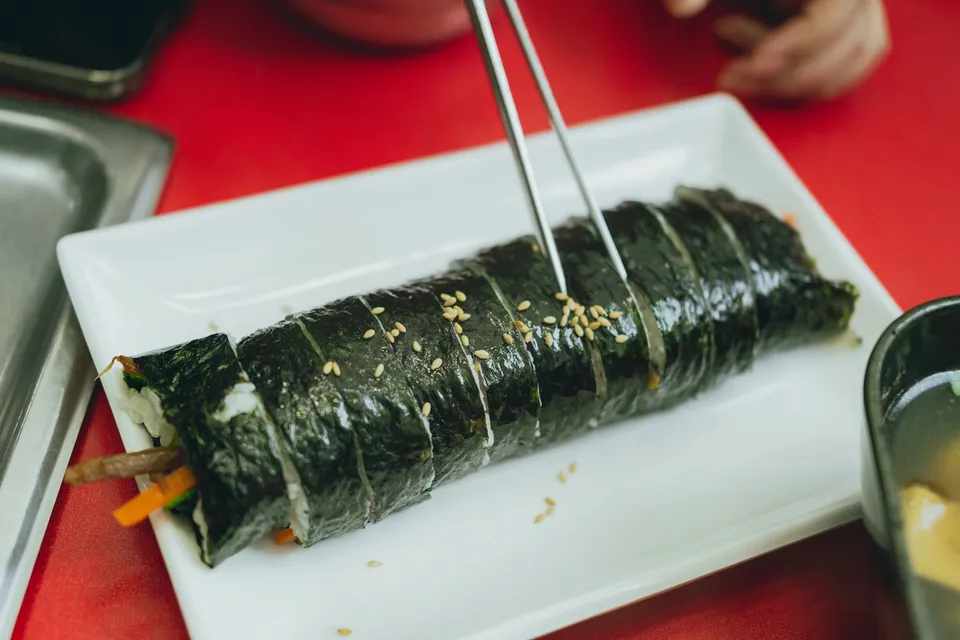
- Photo: Theodore Nguyen on Pexels, a seaweed rice roll in Seoul, used as a similar picture of kimbap. Not a triangle pack and not a named shop.
Questions
What should I buy at a Korean convenience store?
A tuna mayo triangle kimbap at about 1,200 won, a lunch box at about 5,200 to 5,900 won, and a 240 ml banana milk at 1,800 won. Add a cup of ramyeon if you want something hot.
How much does a Korean convenience store meal cost?
A triangle is about 1,200 to 1,800 won and a lunch box is about 5,200 to 5,900 won. Banana milk is 1,800 won for 240 ml. Prices checked October 2026. Check the tag.
How does the ramyeon station work?
For a cup, pour hot water to the line and wait the minutes printed on the cup. For a bag, pay first, then scan the barcode or press the noodle button. It takes about 4 to 5 minutes on a button machine. Bin the cup or the bowl when you finish.
Can I pay with a card or T-money at a Korean convenience store?
Yes. Cards and cash work at the counter. T-money works at GS25, CU, 7-Eleven and emart24 where the logo is shown. The card is about 3,000 to 5,000 won and you load it with cash.
Are Korean convenience stores open 24 hours?
Many branches stay open all night. Some close for a few hours. Read the hours on the door before you count on a late meal.
What does 1+1 mean at a Korean convenience store?
You pay for one and take two. A 2+1 sticker means you pay for two and take three. The discount applies when the matching items are scanned. Read the shelf tag, because the offer changes.